
Bone Density Testing Guide for Charleston Women
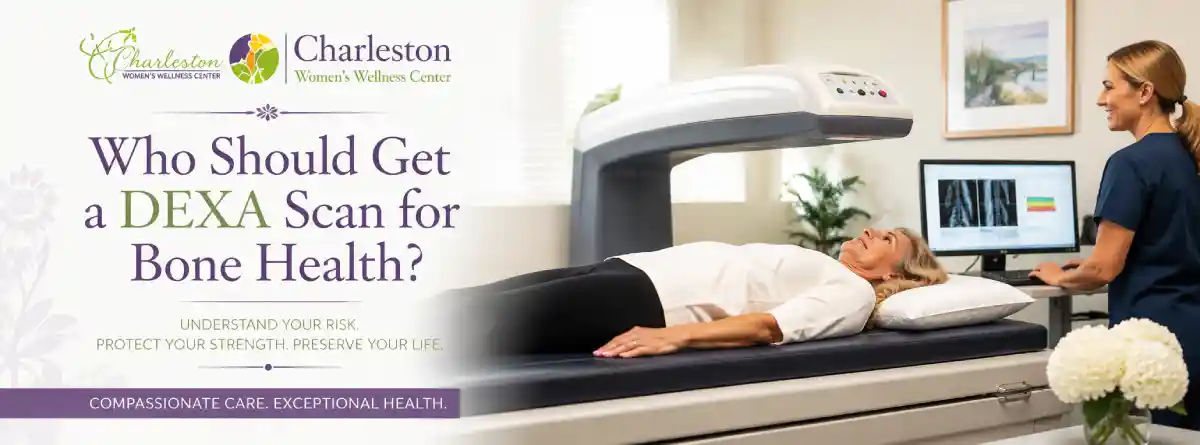
Who Should Get a DEXA Scan for Bone Health?
Quick Answer: Women age 65 and older are generally advised to have osteoporosis screening. Postmenopausal women younger than 65 may also need a DEXA scan when an individual risk assessment shows increased fracture risk. Earlier testing may be considered when there is a history of fractures, long-term use of certain medications, low body weight, smoking, family history, or a health condition associated with bone loss.
Medical Disclaimer: This article provides general education and cannot determine whether you personally need a DEXA scan or diagnose osteoporosis. Your screening schedule should be discussed with a qualified provider who can review your age, menopause status, fracture history, medications, medical conditions, and individual risk factors.
Bone loss usually does not cause an obvious warning sign. Many women first begin thinking about bone density after menopause, after a fracture, or when a provider notices risk factors during a preventive visit. A DEXA scan in Charleston, SC offers a simple way to measure bone mineral density and gather information that may help guide fracture prevention, follow-up testing, lifestyle planning, or treatment discussions.
At Charleston Women’s Wellness Center, Dr. Paula Orr and the care team consider bone health as part of a woman’s broader health picture. Age is important, but it is not the only factor. Menopause status, previous fractures, family history, medication use, body weight, smoking, alcohol use, nutrition, activity, falls, and specific medical conditions may all influence when testing should be discussed.
What Does a DEXA Scan Measure?
DEXA stands for dual-energy X-ray absorptiometry. The scan uses a very low level of X-ray energy to estimate bone mineral density, commonly at the hip and spine. These areas are important because fractures in these areas can significantly affect movement, independence, and quality of life.
The test does not show how a bone feels and cannot predict with certainty whether a fracture will occur. Instead, it adds useful information to a larger risk assessment. A provider may consider the scan results alongside age, prior fractures, family history, fall risk, medications, health conditions, and other factors before recommending the following steps.
Who Is Routinely Recommended for Osteoporosis Screening?
The current U.S. Preventive Services Task Force recommendation supports osteoporosis screening for women aged 65 and older. It also recommends screening postmenopausal women younger than 65 who have one or more risk factors and are found to have increased fracture risk through an appropriate clinical risk assessment.
Women can review the full osteoporosis screening recommendation and then discuss how it applies to their personal health history.
These recommendations are a starting point rather than a substitute for individual care. Someone with a known fragility fracture, a condition that affects bone, or long-term medication use associated with bone loss may need a different evaluation pathway than a woman receiving routine preventive screening.
Who May Need a DEXA Scan Before Age 65?
A younger postmenopausal woman may be advised to have bone density testing when her overall risk is higher than expected. A provider may ask about numerous factors rather than depending solely on age.
- A broken bone after a minor fall or another low-impact event, particularly after age 50.
- A parent with a hip fracture or a strong family history of osteoporosis.
- Low body weight, significant unplanned weight loss, or a history of poor nutrition or malabsorption.
- Current smoking or a history of heavy alcohol use.
- Frequent falls, balance problems, loss of height, or changes in posture.
- Long-term use of medications that may weaken bone, including glucocorticoids such as prednisone.
- Medical conditions that may affect hormone levels, nutrient digestion, inflammation, or bone metabolism.
- Early menopause, surgical menopause, or another reason for prolonged low estrogen exposure.
Having one risk factor does not automatically mean that a woman has osteoporosis. It means the factor warrants inclusion in a personal risk review. The provider can decide whether a DEXA scan, laboratory testing, lifestyle guidance, medication review, or another step is appropriate.
How Menopause Changes the Bone Health Conversation
Estrogen helps support bone remodeling. As estrogen levels decline during and after menopause, bone loss may speed up for some women. That does not mean every woman needs immediate testing at the start of menopause, but it does make bone health an important part of preventive planning.
Women discussing hot flashes, sleep disruption, vaginal symptoms, hormone therapy, or other midlife concerns may also benefit from reviewing calcium intake, vitamin D status when clinically appropriate, strength and weight-bearing activity, fall risk, family history, and screening timing.
Charleston Women’s Wellness Center can coordinate these questions through its menopause and hormone care services.
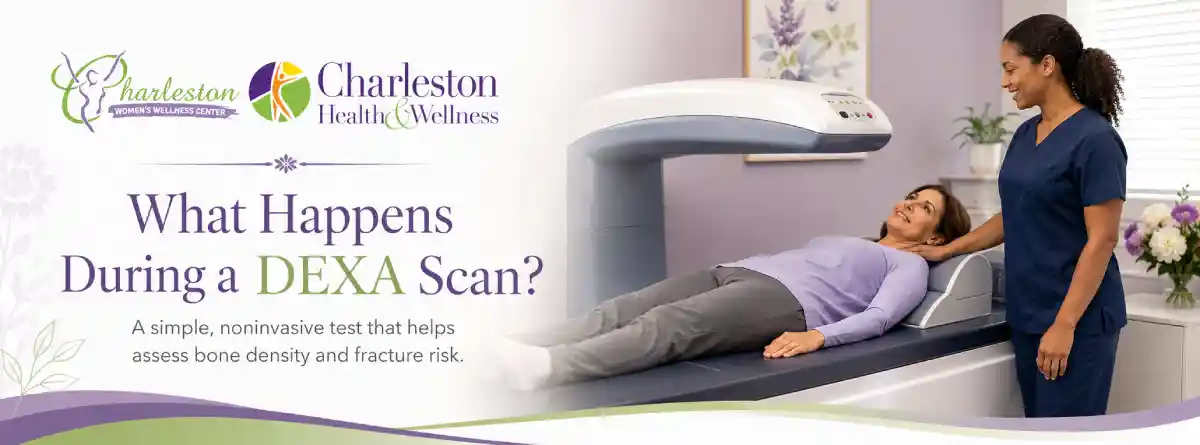
What Happens During a DEXA Scan?
A DEXA scan is generally noninvasive, painless, and open rather than enclosed. The patient lies on a padded table while a scanning arm passes over the body area being measured. The scan commonly focuses on the hip and lower spine and usually requires the patient to remain still for a short period.
Metal can interfere with imaging, so patients may be asked to remove jewelry, belts, or clothing with metal near the scan area. Tell the office before testing if you are pregnant, may be pregnant, recently had contrast imaging, or have hardware or other circumstances that could affect the scan. Preparation instructions can vary, so follow the directions given by the imaging office.
What Do DEXA Scan Results Mean?
DEXA results are often reported with a T-score and, in some situations, a Z-score. A T-score compares bone density with that of a healthy young adult reference population. A Z-score compares the result with people of a similar age and sex. Which score receives the most attention depends on the patient’s age, menopause status, and clinical situation.
A result cannot be interpreted well in isolation. A provider may also consider fracture history, fall risk, medications, family history, and a fracture-risk calculation. The conversation should explain what the result means, whether follow-up is needed, and which steps are reasonable for the individual patient rather than simply labeling the number as good or bad.
How Often Is Bone Density Testing Repeated?
There is no single repeat schedule that fits every woman. Timing may depend on the first result, age, fracture risk, medications, medical conditions, and whether the patient is receiving treatment that requires monitoring. Some women may not need another scan for several years, while others may need closer follow-up.
Repeating a scan too soon may not provide useful information because meaningful bone-density changes can take time. On the other hand, delaying follow-up when the risk is high may leave important changes unnoticed. The safest method is to ask the provider what interval is appropriate and why.
Why This Matters
Osteoporosis can develop quietly. A woman may feel well and remain active even as her bone density declines. Identifying low bone mass before a serious fracture provides an opportunity to review fall prevention, nutrition, activity, medications, health conditions, and treatment options when appropriate.
The purpose of screening is not to create worry about a number. It is to understand fracture risk early enough to take informed decisions that protect mobility, independence, and long-term quality of life.
Common Mistakes
- Assuming bone density testing is only needed after a fracture has already happened.
- Believing that every woman should receive a DEXA scan at the same age, regardless of risk factors.
- Ignoring a fracture after a minor fall because it seemed like an ordinary accident.
- Forgetting to tell the provider about steroid use, supplements, smoking, alcohol use, early menopause, digestive conditions, or family fracture history.
- Trying to interpret a T-score without discussing the complete health and fracture-risk picture.
Best Practices
- Bring a complete medication and supplement list to the appointment, including the dose and how long each product has been used.
- Share any fracture history, falls, height loss, posture changes, family history of osteoporosis, and menopause timing.
- Ask why the scan is being recommended and how the result may change your care.
- Follow the imaging office’s preparation instructions and mention pregnancy concerns or recent contrast studies before the scan.
- Discuss realistic weight-bearing activity, strength training, nutrition, smoking cessation, alcohol use, and fall prevention based on your health and abilities.
- Ask when the next bone-health review or repeat scan should occur instead of choosing a schedule from general online advice.
Local Relevance
Women in Charleston, North Charleston, Moncks Corner, Mount Pleasant, Summerville, West Ashley, Johns Island, Goose Creek, Berkeley County, Charleston County, and nearby Lowcountry communities may receive DEXA testing as part of preventive care, menopause care, or evaluation of a specific risk factor.
Charleston Women’s Wellness Center provides care through Charleston and Moncks Corner offices, and patients can review office locations and appointment information before scheduling.
When to Contact a Women’s Health Provider
Ask about bone density testing if you are 65 or older and have not been screened, are postmenopausal and have risk factors, have had a low-impact fracture, have lost noticeable height, experience frequent falls, use medications that may affect bone, or have a medical condition connected with bone loss.
It is also reasonable to bring up bone health during a menopause or preventive visit, even when you are unsure whether testing is needed.
Prompt medical evaluation is important after a suspected fracture, sudden severe back or hip pain, a fall with difficulty bearing weight, or another acute injury. A DEXA scan is a preventive and diagnostic tool; it is not an emergency test for a new injury.
Final Thoughts
A DEXA scan can provide useful information, but the decision to test should be personal rather than automatic. The best plan considers age, menopausal status, prior fractures, medications, family history, health conditions, fall risk, and how the results may affect care.
Women who have questions about osteoporosis risk or bone density testing can contact Charleston Women’s Wellness Center to ask about DEXA scan appointments in Charleston or Moncks Corner.
Frequently Asked Questions
At what age should a woman get a DEXA scan?
Women age 65 and older are generally recommended to receive osteoporosis screening. Postmenopausal women younger than 65 may also need screening when an individual risk assessment shows increased fracture risk.
Can I need a DEXA scan before age 65?
Yes. Earlier testing may be considered when factors such as a low-impact fracture, long-term steroid use, low body weight, smoking, frequent falls, early menopause, family history, or particular medical conditions increase concern about bone loss.
Is a DEXA scan painful or enclosed?
A DEXA scan is generally painless, noninvasive, and performed on an open table rather than inside an enclosed scanner. You will need to lie still briefly while the scanning arm passes over the area being measured.
What is the difference between a T-score and a Z-score?
A T-score compares bone density with a healthy young adult reference population, while a Z-score compares it with people of a similar age and sex. Your provider should interpret the score together with your fracture history and other risk factors.
Where can I ask about bone density testing near Charleston?
Charleston Women’s Wellness Center offers DEXA scan testing and serves patients through Charleston and Moncks Corner locations. Contact the office to discuss whether testing is appropriate and to ask about appointment availability.
Medical Disclaimer: The information in this article is provided for general educational purposes only and is not intended to diagnose, treat, cure, or prevent any medical condition. It does not replace an examination, diagnosis, treatment recommendation, or personalized medical advice from a licensed healthcare provider. Reading this article or contacting Charleston Women’s Wellness Center through this website does not, by itself, establish a physician-patient relationship. DEXA scan recommendations depend on individual factors, including age, menopause status, medical history, medications, fracture history, and personal risk factors. Contact a qualified healthcare provider for advice specific to your needs. Seek prompt medical attention for severe pain, a suspected fracture, difficulty bearing weight, or another urgent medical concern.